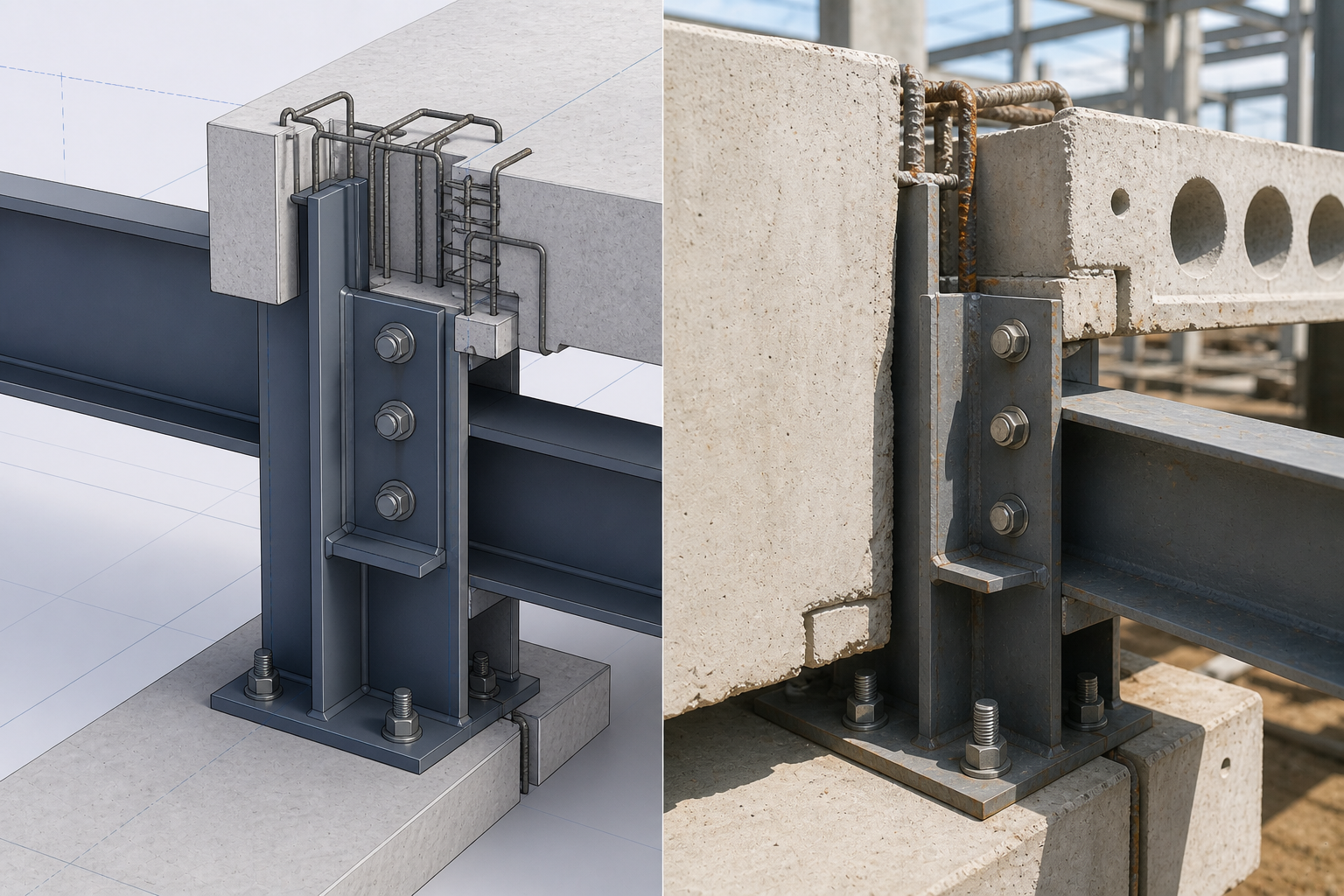
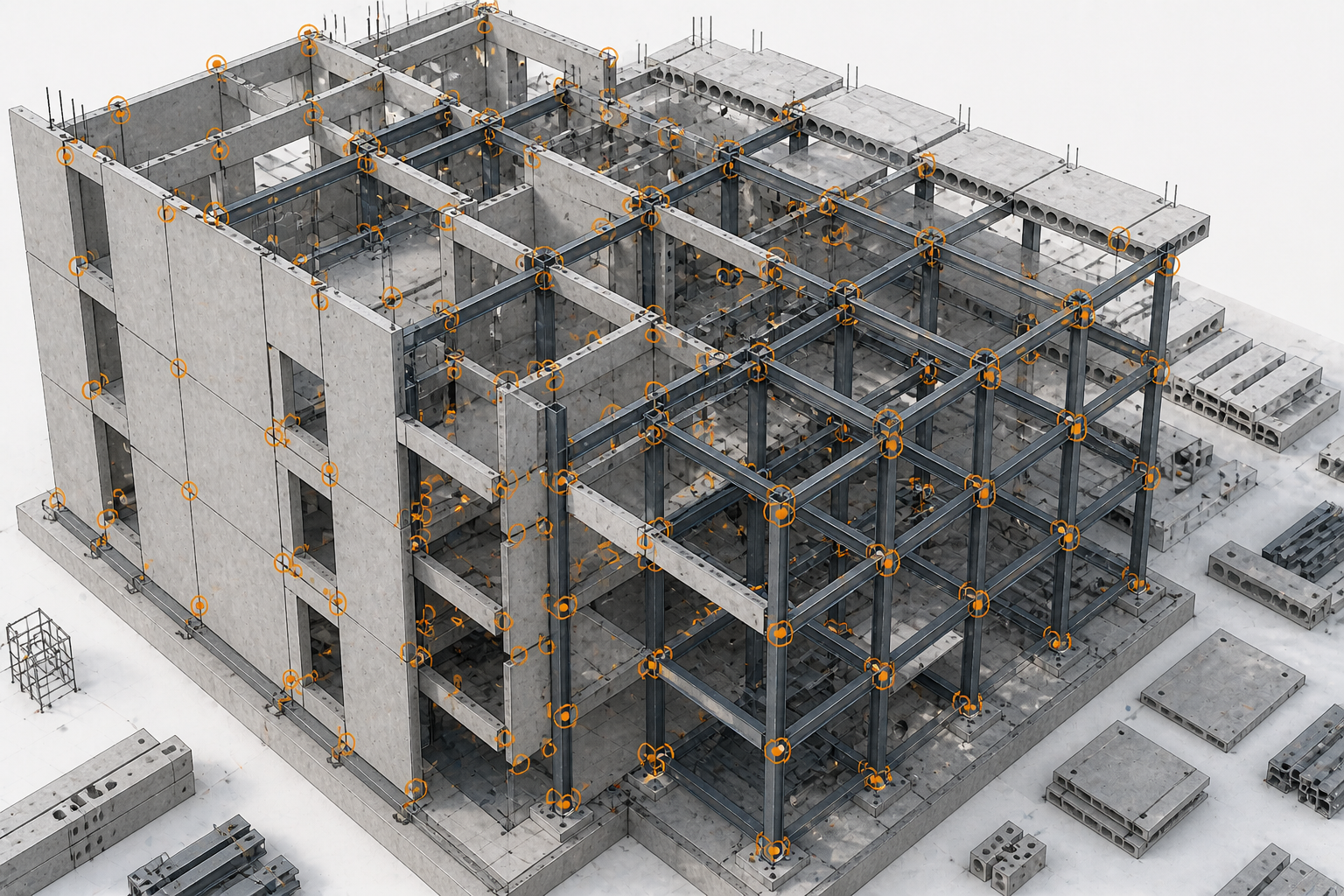
In one of our projects, the challenge involved coordinating more than 4,000 connections between precast concrete elements and a structural steel system.
At that scale, even minor inconsistencies can propagate into significant issues during fabrication and installation. The experience provided clear insights into how coordination quality directly impacts project performance.
The Challenge
The project required the integration of two highly interdependent systems:
- precast concrete elements
- structural steel components
Each connection had to be precisely defined to ensure proper alignment during installation. The complexity increased due to the number of interfaces, the variation in element geometry, and the dependency on accurate positioning of embeds and connection hardware. Given the volume of connections, the project operated with minimal tolerance for error. Any inconsistency in the model would likely translate into rework on-site.
The Problem
Initial coordination revealed several issues that are common in complex precast projects. Differences between models, inconsistencies in connection details, and missing or unclear views. As created conflicts that were not immediately visible in isolated views. As coordination progressed, it became evident that small discrepancies in geometry and positioning could accumulate across multiple connections, increasing the risk of misalignment during installation. Without a structured coordination process, these issues would have reached the construction phase, where corrections are significantly more costly.
The Approach
To address these challenges, a systematic coordination workflow was implemented. The process focused on aligning all project information before fabrication began, ensuring that every connection was validated within the model.
Key actions included:
- model overlay between precast and steel systems
- clash detection and resolution at connection level
- detailed verification of embeds and connection hardware
- centralized management of coordination issues
This approach allowed for early identification of conflicts and ensured that all stakeholders worked with consistent and updated information.
The Result
By resolving coordination issues during the modeling phase, the project achieved a high level of accuracy during execution. Connections aligned as expected, reducing the need for on-site adjustments and eliminating rework related to misalignment. The coordinated workflow contributed to a smoother installation process, improved sequencing, and greater confidence across project teams.
Key Lessons
The coordination of a large number of connections highlighted several critical principles for precast projects:
- coordination must be continuous, not a one-time activity
- small inconsistencies can scale into major issues
- connection-level validation is essential in complex projects
- alignment between disciplines is more critical than individual model accuracy
These lessons reinforce the importance of treating coordination as a central component of project planning rather than a secondary task.
How Biminglabs Approaches Complex Coordination
At Biminglabs, coordination is approached as an integrated process that connects modeling, detailing, and execution requirements.
By combining BIM modeling, detailed analysis, and structured workflows, complex projects can be managed with a high degree of precision.
This ensures that connections are not only correctly defined in the model, but also constructible in real-world conditions.
Conclusion
Coordinating thousands of precast connections is not only a technical challenge, but also a process challenge.
The success of such projects depends on the ability to manage information, align disciplines, and resolve issues before they reach construction.
When coordination is properly executed, even highly complex projects can be delivered with accuracy, efficiency, and minimal risk.
Tags
More from the blog